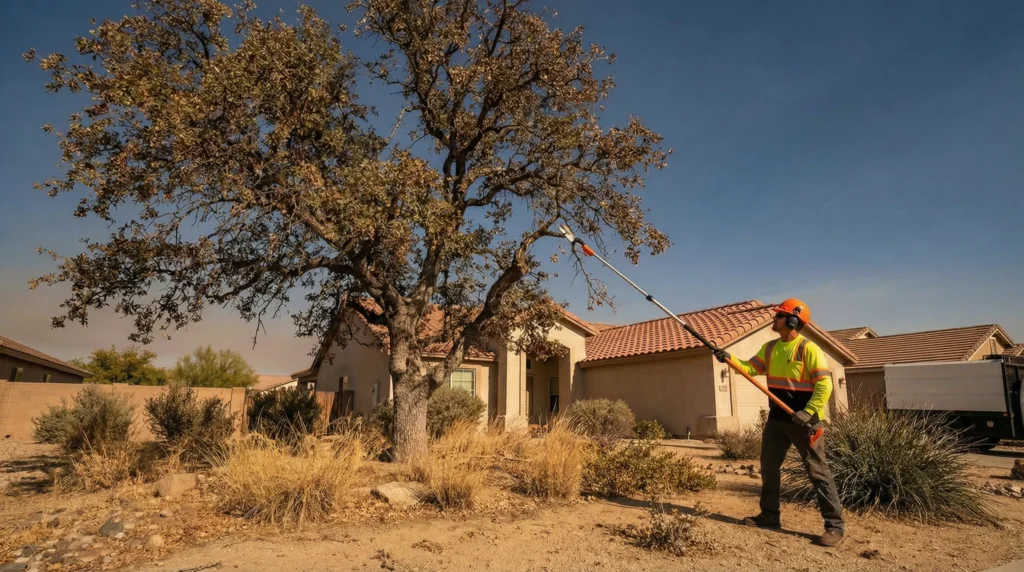
Fire season tree clearing in the Antelope Valley means creating defensible space up to 100 feet from your home by removing deadwood, limbing up lower branches, and clearing dry brush before summer heat arrives. Tip Top Arborists, with 50 years of experience serving Lancaster and Palmdale, helps homeowners meet California’s defensible space requirements safely and efficiently.
Spring is the right time to think about this. By April, the winter rains have faded and the grasses that grew up over the wet months are starting to dry out and cure. By June, the combination of heat, low humidity, and the first Santa Ana wind events of the season can turn a dry yard into a serious fire risk. Getting ahead of that window is the whole point.
The fire season tree clearing Antelope Valley sits squarely on the wildland-urban interface. That means fire does not stay in the hills. It moves through neighborhoods, and the vegetation on your property plays a direct role in whether fire slows down or speeds up as it approaches your home. The good news is that the steps required to protect your property are straightforward, and most of the work can be done in a weekend with the right plan.
Here is what you need to know and what you need to do.
California law requires homeowners in State Responsibility Areas to maintain defensible space up to 100 feet from their structures. Los Angeles County has its own enforcement program that applies to properties in Lancaster, Palmdale, and throughout the Antelope Valley. The framework is built around three zones, each with a specific purpose.
Zone 0 is the most critical area. Research has consistently shown that most homes ignite not from direct flame contact but from embers that land on or near the structure. Zone 0 is designed to eliminate the materials those embers can ignite. This means removing all dead leaves, pine needles, and debris from against the walls, clearing out under decks and in corners where material accumulates, and ensuring no combustible items are stored against the exterior of the home.
If you do nothing else this spring, address Zone 0 first. It is the highest-leverage action you can take.
Zone 1 is your managed landscape zone. The goal here is to reduce fuel continuity so that fire slows down and loses intensity before it reaches your home. Remove all dead plants, dry weeds, and accumulated debris. Prune shrubs so they are not touching one another. Keep tree branches trimmed so they do not hang over the roof. Remove any branches within 10 feet of your chimney.fire season tree clearing
For trees in Zone 1, the focus is on removing deadwood from the canopy and eliminating ladder fuels, which are the low branches and shrubs that allow a ground fire to climb up into the tree canopy.
Zone 2 is about thinning and spacing, not total clearing. The objective is to reduce the density of vegetation so that an approaching fire loses intensity and speed. Cut or mow annual grasses down to a maximum height of 4 inches. Remove dead vegetation and downed branches. Create horizontal spacing between shrubs and trees so fire cannot easily jump from one to the next.
Work through this checklist zone by zone, starting closest to your home and moving outward.
Remove all dead leaves, pine needles, and debris from the 5-foot perimeter around your home, including against walls, under decks, and in corners. Clear out gutters and remove any leaf or needle buildup on the roof. Move any stored firewood, lumber, or combustible materials away from the structure. Check that no tree branches are within 10 feet of the roofline or chimney.
Remove all dead plants and weeds from the 5 to 30-foot zone. Prune shrubs so they are separated from one another and not touching the house. Limb up trees so the lowest branches are at least 6 feet from the ground, or up to one-third of the tree’s total height. Remove all deadwood from tree canopies. Rake and remove accumulated leaf litter and pine needles from the ground.
Mow or weed-whip annual grasses down to 4 inches or less. Remove dead shrubs and thin dense vegetation to create spacing. Clear downed branches and accumulated debris. Check for any dead or dying trees that could fall toward a structure and arrange for a professional hazard assessment if needed.
Many of the tasks above are well within reach for most homeowners. Raking, mowing, and removing small shrubs are straightforward DIY work. Tree work is a different matter.
Pruning large trees, removing deadwood from high in the canopy, limbing up mature trees, and removing hazardous trees all require the right equipment, training, and insurance. Working overhead with cutting tools near structures or power lines is genuinely dangerous, and improper pruning can cause lasting damage to the tree or create new structural problems.
Our ISA-certified arborists at Tip Top Arborists are trained to assess trees for fire risk, structural hazards, and signs of disease or pest damage that may not be visible to the untrained eye. We know the specific defensible space requirements for Los Angeles County and can help you prioritize the work that matters most on your property.
We have been doing this in Lancaster and Palmdale since 1976. We understand the high desert climate, the species common to the fire season tree clearing Antelope Valley, and the conditions that make trees here more vulnerable than those in milder coastal areas.
When should I start fire season tree clearing in the Antelope Valley?
The best time to start fire season tree clearing in the Antelope Valley is April and May. Completing this work before summer heat and Santa Ana wind events arrive gives you time to meet defensible space requirements and address any hazard trees before fire risk peaks.
What are the defensible space zones in California?
California law requires three defensible space zones. Zone 0 is the ember-resistant area within 5 feet of your home. Zone 1 is the lean, clean, and green zone from 5 to 30 feet. Zone 2 is the reduced fuel zone from 30 to 100 feet from your structure.
Do I need to remove all my trees to create defensible space?
No. You do not need to remove all trees to create defensible space. The goal is to reduce fuel continuity by removing deadwood, limbing up lower branches, and maintaining proper spacing between tree canopies so fire cannot easily spread from one to the next.
What happens if my property fails a defensible space inspection in Los Angeles County?
If your property fails a Los Angeles County defensible space inspection, you may be required to correct the violations and face re-inspection. In cases where hazards are not corrected, the county may perform the clearance work and bill the property owner for the cost.
How high should I limb up trees for fire safety?
For fire safety, trees should be limbed up to at least 6 feet from the ground, or to one-third of the tree’s total height, whichever is less. This removes ladder fuels that allow ground fires to climb into the tree canopy.
Tip Top Arborists provides fire season tree clearing and defensible space services throughout Lancaster, Palmdale, Quartz Hill, Leona Valley, Rosamond, Acton, and the surrounding Antelope Valley communities. Whether you need a full property assessment or help with specific trees, our ISA-certified crew is available and equipped to help.
Ready to get your property fire-ready? Request a free estimate from Tip Top Arborists today. Call us at (661) 942-5501 or use our online estimate request form.
[1] CAL FIRE. “Defensible Space.” https://www.fire.ca.gov/dspace
[2] Los Angeles County Fire Department. “Defensible Space Inspection Program.” https://fire.lacounty.gov/fire-hazard-reduction-programs/
[3] Los Angeles County Fire Department. “Annual Defensible Space Clearance Notice 2026.” https://fire.lacounty.gov/wp-content/uploads/2026/01/ANNUAL-DEFENSIBLE-SPACE-CLEARANCE-NOTICE-2026.pdf
Tell us about your tree care needs and our team will follow up with a detailed estimate and recommended solutions.