Thousand Cankers Disease and Walnut Trees in the Antelope Valley: What You Need to Know
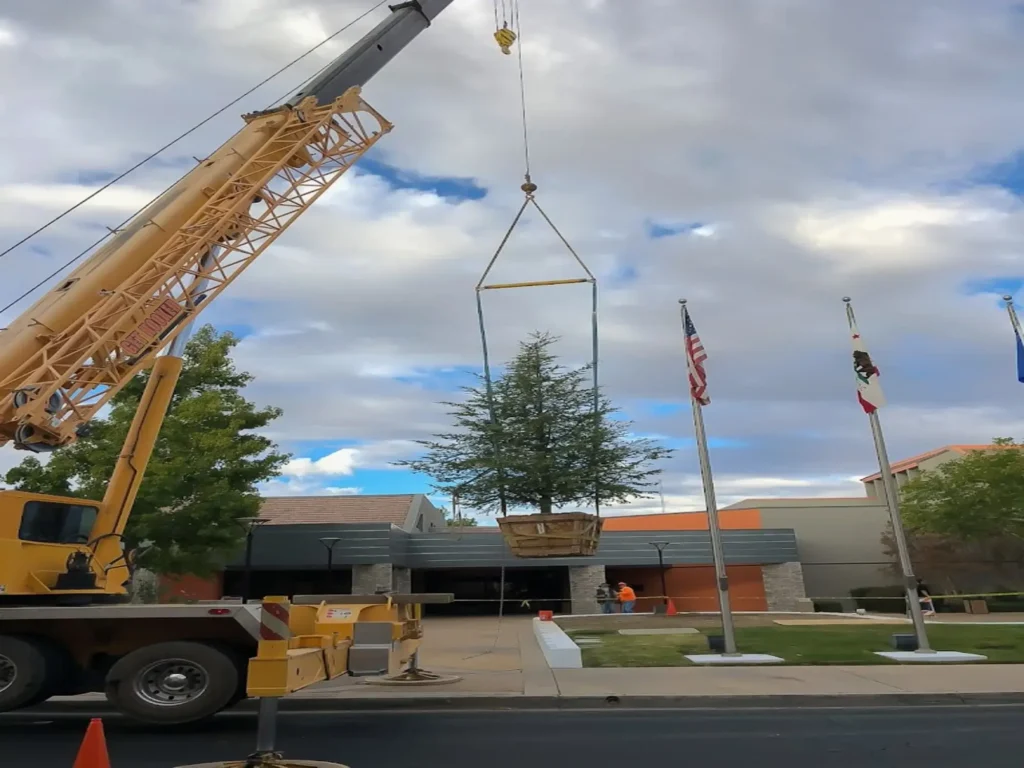
Thousand Cankers Disease Antelope Valley homeowners should watch for canopy thinning, pin-sized holes, and dark staining. Early action matters.
20 Myths About Trees and Tree Care
Physiology / Biology 1. Tree roots systems extend deep below the ground. The large supporting root system near the base of the tree tapers rapidly into smaller roots, with the vast majority of all roots being concentrated in the upper few inches of soil. While a few roots may extend as deep as several feet, it is rare for many to exist at significant depths (more than a few feet). Therefore, protecting these upper layers of soil is critical to maintaining tree health. 2. I should buy the tallest or bushiest tree I can find at the nursery to get the most for my money. The tallest tree may actually be weaker than smaller specimens in the same size container. While aesthetic features are important, tree trunk, branch and root system structure are far more critical to the long term success of the tree. Early structural ( trunk/branches) or root system problems are often the source of failure (breakage) of the tree many years later. 3. A good, strong, stake with strong ties is crucial when planting a tree. While some nursery stock may require staking to remain upright, a tree that is capable of standing on its own should not be routinely staked. Improper or unnecessary staking can create problems that did not previously exist. When faced with significant winds, or a weak specimen, proper staking may be necessary, and can make the difference in a success or failure. However, no type of support system can hold up a seriously defective tree indefinitely. Staking must be viewed and installed as a temporary assist while the tree develops its own strength, and then removed as soon as possible. Pruning and Tree Maintenance 4. Pruning trees or shrubs invigorates them. Pruning, particularly severe pruning, often results in the stimulation of dense, vigorous sprout growth. However, this production of vigorous growth consumes great amounts of the tree’s limited energy, weakening it’s natural defenses. While the benefits of pruning are many, there is always some negative impact from the loss of foliage. Reduction of the foliage mass, however small, means a reduction in the tree’s capacity to photosynthesize, thus reducing the energy available for all its life processes. Progressive techniques can maximize the benefits of pruning while minimizing the negative impacts. Conversely, improper or severe pruning maximizes the negative impacts while realizing very little, if any, of the benefits of pruning 5. Topping: (the removal of the upper portion of a main stem Regardless of technique, topping is always a serious injury to the tree and usually results in serious, long-term structural consequences. A few of the negative impacts of topping: 6. Filling cavities in trees with concrete strengths and helps them heal Filling cavities does not increase structural strength. The process may actually cause harm and increase decay. Generally, management of tree cavities is best left to the tree itself. 7. Making pruning cuts close to the trunk or parent limb will help the tree heal Trees do not heal, in that they do not replace lost tissue, but only cover injuries (e.g., Pruning cuts) with new layers of wood. To minimize decay and promote closing of wounds, do not penetrate the tree trunk but retain the “branch collar” (the slightly raised areas surrounding the base of most branches.) 8. Installing cables, bolts or other hardware will render a hazardous limb or tree safe. Sometimes, to preserve a substantial limb, trunk or entire tree it becomes necessary to provide additional support through the installation of hardware. The installation of cables, bolts and other hardware in trees is intended to reduce hazard potential only and does not permanently remedy structural weaknesses and is not a guarantee against failure. Such hardware must also be inspected periodically and adjusted or replaced as necessary. Chemicals, Amendments and Other Materials 9. Tree seal/ paint (or other tree wound dressings) prevents diseases, decay, insect infestations, or will otherwise help the tree heal Tree sealants (tar, paints, shellac, etc.; ) do not prevent disease, decay, insect infestations or promote closing of wounds. There is actually some evidence that such sealants may actually cause harm. Leave wounds open and allow the tree’s natural defenses to work as intended. 10. Applying a fungicide to a cavity or wound will prevent or stop decay. Trees reduce decay by forming internal chemical barriers at the time of and after wounding. The effectiveness of this process depends on each tree’s genetic characteristics and health at the time of wounding. Treatments after injury (e.g., Tree paint, cutting out decay, chemicals, etc.) Do not assist this process or reduce decay and such attempts often result in additional injury. 11. Annual or regular spraying of my garden will control insects and diseases. Both insects and diseases require timely, targeted efforts for effective management. The best management technique may not be complete eradication, as natural predators (birds, other insects, etc.) Require some food source to remain in the vicinity. Routine spraying with board-spectrum materials not only will not effectively address most problems, but may kill many beneficial insects, fungi and may even effect birds and mammals. 12. If I use a strong enough pesticide or fungicide, I can cure any insect or disease problem. There are no blanket chemicals or schedule that can control all the insects and disease problems your plants may encounter. In fact, many diseases of plants have no known chemical controls. 13. Adding good topsoil, soil amendments and fertilizers when planting or transplanting is crucial to a plant’s success. To significantly improve poor soils, a very large quantity of amendment (additions such as sand, redwood mulch, etc.) would be required over a very large area. Amendments in the planting hole alone will likely have more negative effect than benefit. Planting a new tree after stump grinding can be particularly challenging, as the soil might need additional adjustments to support the tree’s long-term health. It is far more critical to plant at the right depth, in the right location for the species and to
Top 10 Tree Problems in Los Angeles
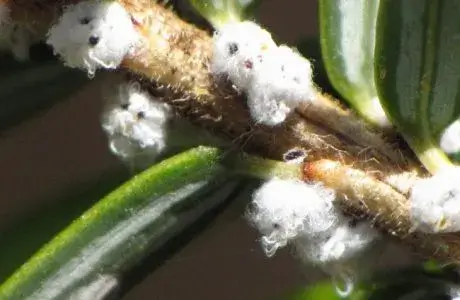
Many tree problems in the Los Angeles metropolitan area are caused by insects and diseases. These problems can completely threaten the health, beauty and life of your trees. Our certified arborists have listed below the Top 10 problems that can plague trees in Antelope Valley, Santa Clarita Valley, Tehacapi Valley and Victor Valley. Lace Bugs Lace bugs target broad-leaf evergreens such as andromeda, azalea, and rhododendron. Early detection is the key to getting rid of an infestation. Look for yellow-silver stippling on the topsides of leaves. Mites Mites pose a serious threat a wide variety of plants, and can seriously impact the visual appearance of a plant. Mites favor warm, dry climates, and are an extremely serious issue for many homeowners. Tent Caterpillars Caterpillars can weaken many trees and shrubs, increasing the chance of a secondary infestation. Look for silken, yellow cocoons. Borers Borers are attracted to unhealthy trees, burrowing in and laying eggs inside the trunk. The best defense against borers is to keep your trees healthy and unstressed. Hemlock Woolly Adelaide One of the most common pests, these insects can cause the death of a tree if left untreated. They leave behind a telltale white wax and target primarily older trees. Scale Insects These insects target primarily hardwoods and conifers. Some signs of an infestation include abnormal leaf and shoot growth, yellow or red leaves, and branch grouting. Anthracnose Disease This fungal disease affects deciduous and flowering trees. Look for a spotting of foliage in spring and summer. Winter Injuries Even during mild winters, evergreens can lose moisture and not be able to replenish it. Thus, make sure your evergreens have sufficient soil moisture. Weevil Insects Weevils are commonly found on flowers and fruits. Look for notches around the edge of leaves. Aphid Insects Aphids are small and pearl shaped. An infestation can cause yellow discoloration and defoliation. but as this year’s bounty. Remember the rule when picking – two for the bucket, one for the mouth. Bon appetite!
What Are Hidden Underground Hazards?
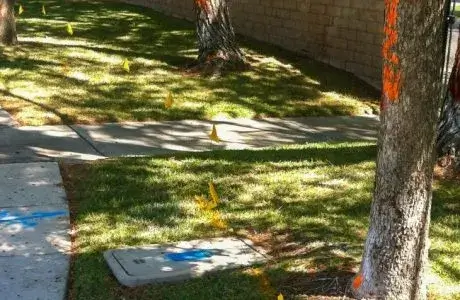
For many people, the idea of planting or removing a tree is a simple concept – dig a hole to plant, or dig up the stump and yank. Yet there is so much more under the ground than many realize. When you turn on that light switch, light the top burner on your stove or even make that phone call (if you still have that archaic land line attached to the rotary phone), those services get to you most likely from underground cables and pipes. It doesn’t take much to sever those services with a shovel, and the results can be disastrous – shockingly so. So, before you decide to wear a pair of angel wings, riding on top of a mushroom cloud caused by a natural gas explosion, call your local utility companies to have the area you are working in marked. Your family and friends will love you for it. If you don’t have the utility company numbers on speed dial, contact DigAlert (https://www.digalert.org/) by pressing 811. It’s more preferable than 911.
Overcoming The Urge To Top A Tree
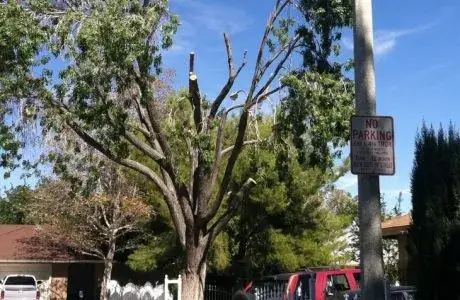
How many times have you looked at your tree and said, “That tree is too tall. I need to have it topped!” Come on, I know you’ve at least thought it, right? You might remember that sign at the amusement park stating “You must be this tall to ride”. Trees have no owner’s manual that say “I’m not allowed to exceed 30 feet”. Before you make the decision to reduce the height of any tree, do your research. Let me tell you why… TOPPING HURTS TREES! When a tree is topped, the upper crown is cut indiscriminately at a point that may not heal, also creating subsequent limbs that are more hazardous than what was removed. And that is just the beginning. We suggest you read this helpful brochure about Why Topping Hurts Trees. If you need to reduce the height of a tree, make sure you speak to one of our certified arborists to learn about the pros and cons.od but as this year’s bounty. Remember the rule when picking – two for the bucket, one for the mouth. Bon appetite!
Why Should An Arborist Trim My Trees?
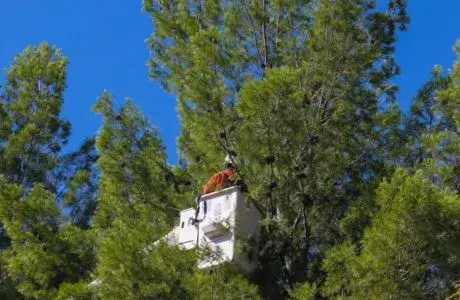
Now that spring is around the corner, and temperatures are on the rise, trees are coming out of their slumber and treating our senses with leaves and flowers of magnificent color and smell. It is also the time most people say, in their best Thurston Howell the III voice, “My dear, I think we need to call our arborist.” Seriously – no they don’t. Most people will call the first name they see on the flyer taped to the bus bench or mass-produced business card stuck under the windshield whiper on their at the local strip mall. Or they may see a pickup truck with a ladder and a chain saw driving around their neighborhood with the advertisement “We Slash & Dash” plastered on the tailgate. What exactly IS an arborist? Well, he’s the ISA version of a licensed AMA Beverly Hills plastic surgeon, not your back alley non-licensed deals on wheels working out of an old ice cream truck. Let me put it another way – a Yugo with a Mercedes emblem is just a….” Okay, you got it. Now that I’ve painted a masterpiece in visual pastels, let’s get to the black and white. An arborist is a professional in arboriculture, the study of trees, vines and other woody plants, along with their cultivation and management. He is trained and experienced in the identification, diagnosis, care and maintenance of your trees and plants. These trees and plants are no less a part of your family than are your children, and you should entrust them with the same care you expect from your health care professional. He’s not the professional only millionaires can afford. Up to now, you’ve spent a commodity much more precious than money on your landscape – time. That is something you can never get back once you hire Joe Hack-a-Limb to perform his impersonation of a professional arborist. So, back to Joe Hack-a-Limb, working out of that deals on wheels ice cream truck – do you really want him around your property?
Can I Trim My Neighbor’s Overhanging Tree Branches?
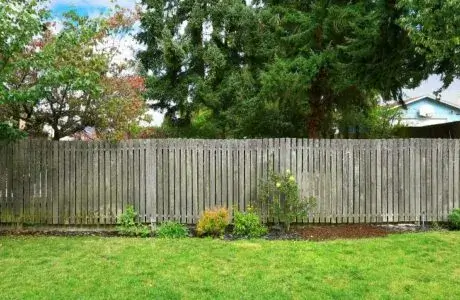
“My neighbor’s tree has branches crossing over my fence. Can you cut them back to their side? And while you’re at it, can you cut all the roots that are in my lawn?” If I had a dime for every time someone asked me that question, I’d be the better looking version of Bill Gates. No, not really, but I would be able to take the wife to a dinner and show at the dollar theater. Most of the public believes that they have the sovereign right to do whatever they want to do. Especially when it comes to branches or roots that encroach from a neighboring property. …but that isn’t true. Let’s look back at how the courts have ruled on this issue so we have a better understanding of the legal ramifications. In the 1994 case of Booska v. Patel, Patel (the neighbor) hired a contractor to remove the roots from the large Monterey pine his neighbor (Booska) owned. Patel claimed the roots had started to damage concrete around his property. The contractor dug a 3′ trench along the property line, effectively severing a significant portion of roots needed to survive. This damaged forced Booska to remove the tree, at his own expense, and to seek legal judgement. Ultimately an appellate court handed down a judgement that awarded him significant restitution. So, you’re wondering – is this the only case? Au contraire… In the 2012 case of Rony v Costa, a property owner hired an unlicensed day laborer to trim limbs that crossed his property line from a neighboring tree. Instead of researching the issue, the day laborer was turned loose on the trees like Jason in Friday the 13th. Except the trees were the unlucky cabin campers. For his efforts, the property owner was forced to pay restitution in excess of $45,000.00. Yes, THAT much. So, what is the take-away from all this you ask? First, familiarize yourself with your responsibilities as a property owner. Second, hire a certified arborist that knows the law and what you may and may not do. When people call us for an estimate on property line trimming, we ALWAYS start by informing them as to what their rights and responsibilities are. We also explain that what they want to do may not be legal or give them the outcome they desire. Ultimately, if there is no possible way of seeing eye to eye with your neighbor, consult lawyer that is familiar with aboriculture law. Click here for frequently asked questions to help you deal with troublesome trees on or near your property. trained in tree pruning to ANSI standards. Once you master this, you’ll not look at the trees as next year’s firewood but as this year’s bounty. Remember the rule when picking – two for the bucket, one for the mouth. Bon appetite!
10 Questions To Ask A Prospective Contractor

As a consumer, it is your right and responsibility to ask a contractor you might hire a few qualifying questions. The answers to these questions will determine whether or not you want him on your property, working for you. We at Tip Top Arborists welcome these questions because we now know that the potential client is concerned about their property and quality of work performed, NOT just the cost. So, what questions should be asked? Here are ten (10) common ones. 1. How long has your company been in business? Experience does matter. A seasoned contractor will provide you the peace of mind knowing that he can produce promised results. You have an investment in your property that you wouldn’t want to hand over to a novice – would you? 2. May I see your contractors license? States have stringent requirements for applying for a contractor license . In California, if you are performing work that exceeds $500.00 in labor/material you must be a licensed contractor. There are different types of licenses, too. Don’t hire someone that has a license for Landscaping (C-27) when you want Tree Trimming (C-61/D49). No only is the experience different, but what their insurance covers too. Here’s another item to note – California state law requires all forms of advertisement (cards, ads, truck signs, etc) carry the contractor’s license number. If you call that business card left on your front door or under your windshield wiper and ask the person that answers the phone for their license number, don’t be fooled by the “I’m sorry, I can’t give that to you until I come out to your house” spin. 3. Do you have a copy of your Liability and Workers Compensation insurance? Liability insurance protects your property from damage. Workers Compensation insurance protects YOU from a contractor’s employee injury on your property. Ask the prospective contractor for copies of both. If you hire a contractor that is uninsured, YOU take the responsibility of insuring them per CA Labor Code § 2750.5. (For an example of the consequences of hiring an uninsured company, refer to Fernandez v. Lawson). A contractor working out of classification may not carry the insurance to cover the work he is performing. While no one ever wants to be faced with an injury on the job site, one needs to be prepared. You, as the individual hiring a contractor, should have peace of mind knowing that the unforeseeable is covered. 4. How long will the job take? This is a question most don’t ask, but should. Your job should be the focus of your contractor and worked until completed. Only Mother Nature or some other unforeseen issue should delay completion. 5. What is your payment schedule? You NEVER pay the job up front, and a reputable contractor will never ask you to. California law states a contractor may not ask for more than 10% of the total job or $1000.00, whichever is less. Full payment upon completion of job is standard unless previous financial arrangements are made before the commencement of work. 6. Who will you send to perform the work? You should expect consistency from your contractor, especially with jobs that may take more than one (1) day. Tip Top Arborists will send only ISA-trained individuals will be sent to your project site, NOT someone picked up at your local home improvement outlet. 7. How do I stay in contact with you? In today’s world of technology, staying in touch should be easy. Whether it be texting, emails, phone calls or that oft-forgotten face to face conversation, have the discussion with your contractor on how it will be best to communicate. 8. What hours will you be working, do I need to be there and is there anything I need to prepare for? Your contractor should be able to give you a window of arrival time. For crews that have multiple jobs scheduled for the day, the first job of the day is usually the only one with a guaranteed start time. Most cities have a noise ordinance that, for weekdays, is usually 7 AM. To stay, or leave, is up to you. For the most part, tree trimming doesn’t require a homeowner present. But if you have a special bird bath given you by Great Aunt Gertrude, or a prized ’57 Chevy hubby is restoring, make sure those are brought to the attention of your contractor and crew. 9. What will my property look like at the end of the day? Any professional contractor will ensure that your property is clean at the end of the work day, whether it was a 2 hour job or one that runs multiple days. Tip Top Arborists treats your property as if it was our own. 10. How do you protect my property during work? Before work starts, the crew should walk the property looking for items that need to be moved or protected. Pictures of any existing damage should be taken and sent to the client before work starts to document the site. Remember Great Aunt Gertrude’s bird bath? The ’57 Chevy? Those items, and many other on the property, will be moved/protected during work. Plants, pool, patio furniture will be covered as required and any windows that might be at risk will be protected. At the end of the job, the site should look as good, if not better, than when the crew entered the property.
Are There Dangers In Cutting Tree Roots?
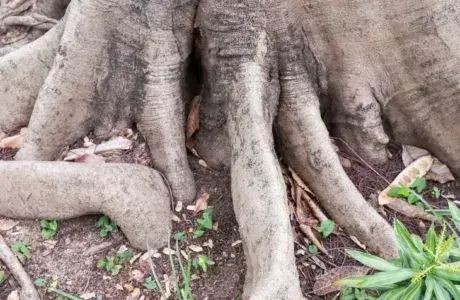
“Honey, I am so tired of looking at those roots in our front yard! I’m going to have the neighbor’s gardener, Joe Schmo’s Tree, Landscape, Automotive Repair and Concrete Service come over and cut them all out, okay?” Whoa there, Nellie!! There are many reasons why one sees roots in their lawn, and it isn’t necessarily because the tree is unstable or looking for water. Before you take a hatchet to those roots you first need to know what they do, why they are there and the law of Unintentional Consequences if you were to remove them. The Function of Roots Roots have two (2) basic functions – structure and feeding. Structure roots are those that start in at the base, growing under the canopy of the tree. As these roots move outward, they become smaller and smaller in diameter much like the structure of the limbs you see above. Their job is to provide a stable foundation. The feeder roots are small and fibrous and their job is to feed the tree, providing nutrients and water. So, you can see the distinct difference. Most people, when seeing roots, only see the structure roots, not the whole picture. The Pruning of Roots Remember the homeowner Nellie that wanted to go Lizzie Borden on the roots in her front yard? She doesn’t understand what potential consequences her actions may have on her tree. Here are just a few to consider – Construction and Landscape Renovation Adding onto the house for the out-laws? Installing a pool? Or just renovating your landscaping? These are another common area where roots have the potential to be cut and damaged. If you are installing a new irrigation system in your yard, try to incur minimal damage by installing irrigation like spokes on a wagon wheel as shown. Remember this rule of thumb – a tree will put out a root system at least as wide as the drip line. What do I need to know if I must prune roots in my yard? First off, remember that root pruning should NOT be for aesthetic reasons only. If the roots are damaging walkways or foundations, that is a different issue. But remember what we’ve discussed – pruning roots can have a negative effect on the tree. In your desire to save the foundation you might have weakened the tree causing it to fall on your roof. Ouch! Reach out to your local arborist for his professional opinion. Next, don’t cut roots larger than 2″ in diameter. The maximum one should consider removing in one procedure is 20% of above-ground roots. Again, remember the potential consequences. Is there a better time of year to prune or remove roots? Yes. winter thru early spring is the best time, as that is when there is the least stress on the tree. So, what do we take away from this. Yes, roots can be pruned with the knowledge of how/why they exist. They can also be pruned knowing what the potential outcome may be. If you are not sure, contact your local arborist for a consultation.
How Does Drought Affect Trees?
What Is “Drought” Before we start, we need to understand the definition of ‘drought’. Drought can be defined as a prolonged and exceptional deficit between water supply and demand. In other words, long term conditions of high demand and low supply equals drought. Many of us in the Southwest have experienced first hand the effects of years of drought, especially those living in California from 2011 thru 2017. With mandatory water restrictions to increased dusty conditions, the drought has altered all of our lives. However, many don’t know just how damaging the drought has been to trees that have been dependent on Mother Nature, both in natural and in domestic settings. Drought in Natural Setting First, let’s take the trees that are in natural settings. From the deserts to the mountains, native trees and plants depend on irrigation to not only grow but to defend themselves from outside pestilence. Hold on a minute. We just heard the phrase ‘defend themselves’. What does that mean? The simple answer is that when trees become stressed by lack of irrigation, they must redirect the energy allocated to defense and apply it to survival. In humanistic terms, you work long days for weeks on end, not getting the proper rest and nutrition, and eventually your defenses are down. The next thing you know, along comes the common cold or flu. You sneeze and sniffle, blowing you nose from time to time and that tells everyone around you that you are sick. Guess what – trees do the same. Okay, so none of us have ever heard a tree sneeze, but it does release chemicals such as ethanol, acetaldehyde, ethylene and ethane when stressed. These chemicals are catnip for ambrosia beetles, “secondary” bark beetles, and weevils. For our topic we’re going to talk about the secondary bark beetle effect. Bark Beetles The bark beetle attacks the weakest trees first, like the lion on the Serengeti attacks the slowest antelope in the herd. No, the bark beetle doesn’t have a long flowing mane and long tail. Instead, it’s only 1/8” to 3/8” in length. Not particularly daunting in size, right? Don’t let that fool you. When these beetles team up, they burrow through the vascular system of the tree, cutting off the flow of nutrients to and from the tree. Have you ever taken a sip through a soda straw that has a hole or slit, only to end up with a mouthful of air? Exactly what is happening here. Since the tree cannot distribute nutrients throughout the canopy, the furthest extremities will start to die off from starvation, eventually causing the entire tree to die. Meanwhile these bark beetles reproduce, flying off to infect the next victim. Not a pretty picture. Drought in Urban Setting Now let’s talk about trees in the urban setting. When the drought became a prolonged event, many cities have imposed watering restrictions in non-essential areas, such as landscaping. To comply with these restrictions, much of the public significantly reduced or eliminated the irrigation to the landscape which effected the trees residing in these areas. While at first these trees didn’t look as though affected by this reduction, internally they started going through the same stress process as those trees described in natural settings. These are signs of a tree in stress: Remember the bark beetle attacking native trees? They went after similar species of trees, and their cousins went after other varieties. Talk about a full-blown assault on our urban greenscape! Effects Installing Drought Tolerant Landscaping Doubling down of the drought water restrictions, many individuals went with native/drought tolerant landscape that required minimal irrigation. Through this process they laid down fake turf or plastic upon which they placed material such as gravel, bark or decomposed granite. This material in essence covered the roots of existing trees, robbing them of oxygen, water and nutrients while baking them under intense heat. Imagine trying to go throughout your day with a plastic bag over your head. I think you get the point. What You Can Do Now years into the drought, trees are falling over in our urban living areas. Cars are crushed, houses damaged and the public put at risk. What do we do? First off, contact an Arborist to look at your trees and give you an assessment of what he/she sees. He/she should ask you questions about the tree just as a doctor asks you questions about your history. This will help him/her provide a better assessment and recommendations. The effects of the drought will linger for years, if not decades. Make sure you do your part in protecting your trees, all while prevention potential risks to both person and property.