If you live in Lancaster, Palmdale, or the surrounding Antelope Valley, deciding to remove a tree is rarely as simple as just firing up a chainsaw. Between city ordinances, county regulations, and strict state laws protecting native species, cutting down the wrong tree without permission can result in massive fines and legal headaches.
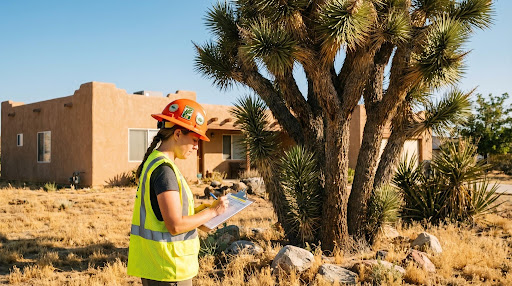
A professional ISA-certified arborist from Tip Top Arborists inspecting a large native oak tree in Lancaster, CA, preparing a tree risk assessment report for a removal permit.
The short answer to “do I need a permit to remove a tree in Lancaster” is: it depends entirely on the type of tree, where it is located on your property, and its current health.
This guide breaks down exactly what you need to know about tree removal permits in the Antelope Valley for 2026, including the strict new rules around Joshua trees and native oaks, so you can handle your landscaping safely and legally.
If you only remember one thing from this guide, make it this: never touch a Joshua tree or a native oak tree without consulting a certified arborist first. Both are heavily protected, and the penalties for illegal removal are severe.
The Western Joshua Tree is an iconic symbol of the high desert, but it is also the most heavily regulated plant in the region. Under the Western Joshua Tree Conservation Act (WJTCA), which took effect in July 2023 and remains strictly enforced through 2026, the Western Joshua Tree is a candidate species under the California Endangered Species Act (CESA) [1].
The Rules: You cannot remove, transplant, trim, or even intentionally damage a Western Joshua Tree (dead or alive) without an Incidental Take Permit (ITP) or a Hazard Management Permit from the California Department of Fish and Wildlife (CDFW) [2].
Hazard Management Permits: The state does offer free Hazard Management Permits to property owners, but only if the tree meets very specific criteria. You can only get a permit to remove a dead tree, or trim a living/dead tree, if it has fallen over within 30 feet of a structure, is actively leaning against a structure, or creates an imminent threat to public health or safety [2]. These permits cannot authorize the complete removal of a living Joshua tree [2].
Transplanting: You cannot simply dig up a Joshua tree and move it out of the way of your new driveway. Relocation requires a full permit and must be conducted according to strict CDFW guidelines [1].
If you live in unincorporated areas of Los Angeles County (like parts of Quartz Hill, Leona Valley, or Acton), your oak trees are protected by the Los Angeles County Oak Tree Permit Ordinance [3].
The Rules: An Oak Tree Permit is required to cut, destroy, remove, relocate, inflict damage, or encroach into the protected zone of any tree of the oak genus that is 8 inches or more in diameter (measured 4.5 feet above the ground), or any oak with multiple trunks that have a combined diameter of 12 inches or more [4].
The “protected zone” extends 15 feet outward from the trunk, or 5 feet beyond the edge of the tree’s canopy, whichever is larger. This means even trenching for a new irrigation line under an oak tree requires a permit [4].
The trees planted in the “parkway” — the strip of land between the sidewalk and the street — usually belong to the city or county, not the homeowner.
If a parkway tree is dead, diseased, or lifting your sidewalk, you cannot remove it yourself. In Los Angeles County, you must apply for a Road Encroachment Permit through the Department of Public Works just to trim or remove a parkway tree [5]. The City of Lancaster has similar requirements for any work that physically changes or adds value to the property, including work in the public right-of-way [6].
If you have an issue with a street tree, your best course of action is to contact the city or county directly, or hire a professional tree service that understands how to navigate municipal permitting.
For most standard landscape trees located entirely on your private property — such as a dying pine, a messy eucalyptus, or an overgrown mulberry — the City of Lancaster generally does not require a specific tree removal permit, provided the tree is not a protected species and is not located in the public right-of-way.
However, there are two major exceptions you must watch out for:
When you do need a permit — especially for a hazard Joshua tree or a diseased oak — the city or state will not just take your word for it. They require proof that the tree is actually dead, dying, or dangerous.
This is where an ISA Certified Arborist comes in. A professional arborist can provide a formal Tree Risk Assessment or Arborist Report. This document details the exact species, health, structural integrity, and risk level of the tree. When you submit a permit application to the CDFW or LA County Planning accompanied by a detailed report from a credentialed expert, the approval process is significantly smoother and faster.
Tree removal in California is heavily regulated for a reason, but navigating the red tape shouldn’t keep you from maintaining a safe and beautiful property.
At Tip Top Arborists, we have been serving Lancaster, Palmdale, and the Antelope Valley since 1976. Our ISA Certified Arborists know the local ordinances inside and out. Whether you need a simple removal in your backyard or a complex hazard assessment for a protected species, we can guide you through the process legally and safely.
If you are unsure whether that leaning tree needs a permit, don’t guess. Contact Tip Top Arborists today for a professional consultation.
Tell us about your tree care needs and our team will follow up with a detailed estimate and recommended solutions.