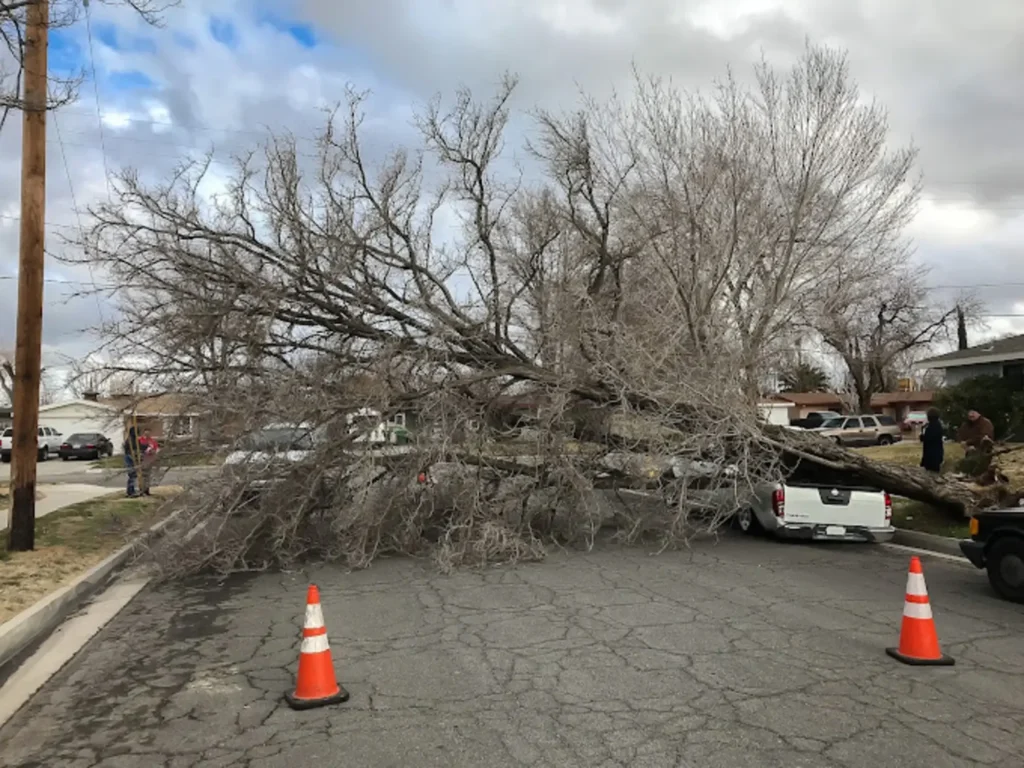
If you live in Southern California, you already know Santa Ana winds can turn a calm day into a mess fast. These dry, powerful gusts can drop large limbs, uproot trees, and push trees into roofs, fences, and power lines. When that happens, you are not just dealing with cleanup. You are dealing with a safety situation where emergency tree removal may be the next step.
This guide explains why trees fail during Santa Ana events, what warning signs to look for before the wind picks up, and what to do the moment a tree comes down.
Santa Ana winds are warm, very dry winds that blow from inland areas toward the coast. They form when high pressure builds over the desert Southwest and air flows toward lower pressure near the California coast, funneling through passes and canyons. These winds are most common in the cooler months, often from September through May. (National Weather Service)
For emergency tree removal, the danger is not just wind speed. It is the combination of gusts, low humidity, and long-term drought stress. Dry soil can reduce root grip, dry wood is more brittle, and stressed trees are less able to handle sudden loading.
Whole-tree failure often starts underground. Shallow roots, restricted root zones (concrete, compacted soil), or roots damaged by trenching and construction can reduce stability. Under repeated gusts, the root plate can lift and the tree can tip.
Even when a tree stays upright, heavy limbs can break. Deadwood, weak branch unions (tight V-shaped forks), and unbalanced canopies act like sails. A large limb falling from height is an immediate hazard, especially near driveways, patios, and walkways.
If a rare rain event happens before a wind event, saturated soil can lose holding strength. That can make uprooting more likely even if the tree looked stable a week earlier.
Do a quick walk-around before Santa Ana season and after any big wind day. If you spot more than one of these, schedule an assessment before the next event.
If you want an expert opinion before things turn urgent, book a professional assessment and pruning plan (not just a trim) so your trees handle wind better over time. You can also review our approach to proper pruning on our Tree Pruning page.
If a emergency tree removal is touching electrical lines or you see lines down, do not approach. Stay well back and call 911. Southern California Edison’s guidance is to stay at least 100 feet away and avoid touching anything in contact with the line, including wet ground. (Energized by Edison)
Hanging limbs can drop without warning, especially while winds are still active. Set a wide “no-go” zone around the tree and any nearby trees that look stressed.
Take photos and video from multiple angles. Capture the impact point, the full tree, and any damage to rooflines, fences, vehicles, or windows. This helps with insurance and protects you if questions come up later.
This is not a DIY job. Fallen trees are often under tension and compression. One wrong cut can shift the tree, cause more structural damage, or injure someone. If you need immediate help, start here: Emergency Tree Removal.
Emergency tree removal pricing is higher than scheduled work because it often involves after-hours labor, hazard conditions, and specialized equipment (rigging, bucket trucks, cranes). Your final cost depends on tree size, access, what it hit, and how fast it must be made safe.
Insurance often depends on impact:
If you are dealing with storm damage specifically, this page can help you understand the removal and documentation process: Storm Damage Tree Assessment & Removal in Lancaster, CA.
Santa Ana conditions can line up with extreme fire behavior because vegetation dries out quickly and embers spread fast. Maintaining defensible space and reducing dead fuel around structures helps reduce risk. California’s defensible space guidance includes Zone 0 (0 to 5 feet) and Zones 1 and 2 out to 100 feet, with vegetation management required by law in many areas. (readyforwildfire.org)
You cannot control the wind, but you can reduce the chance your trees fail.
If you are unsure whether a tree is a hazard, start with an evaluation instead of guessing.
If a tree is down, leaning hard, or threatening a structure, do not wait for “daylight” if conditions are unsafe. Prioritize safety and get a qualified crew on site.
For immediate scheduling and a written estimate, contact us here: Contact Tip Top Arborists.
Tell us about your tree care needs and our team will follow up with a detailed estimate and recommended solutions.