
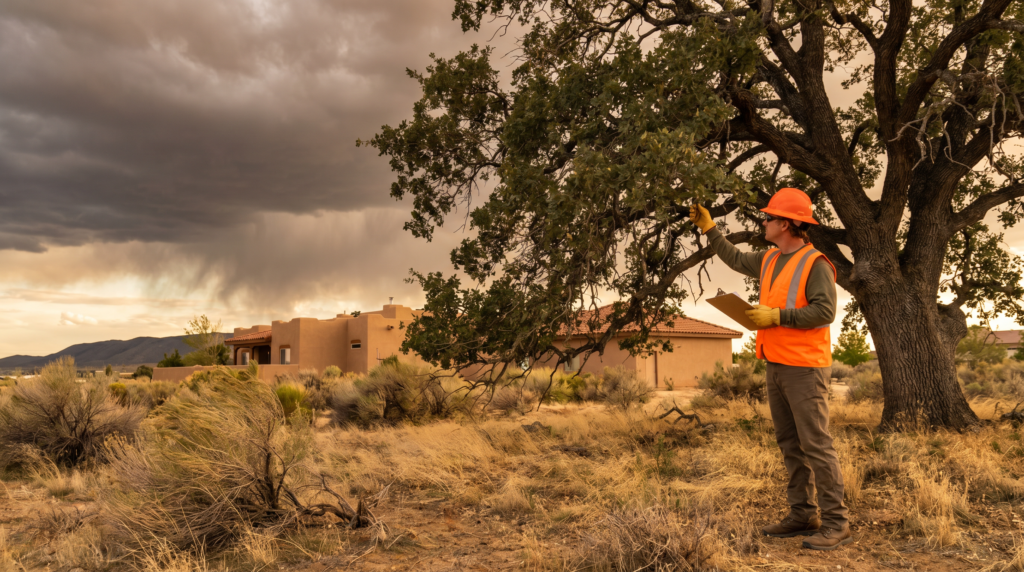
Prepare trees for wind and rain season Antelope Valley to protect your property before storms arrive.Rain and wind are forecast for the Antelope Valley this week, with gusts expected to reach 35 mph by Tuesday. For homeowners in Lancaster, Palmdale, and Acton, that kind of weather is not just an inconvenience. It is a test that every tree on your property will either pass or fail. A well-maintained tree sheds wind and sheds water. A neglected one becomes a liability.
Tip Top Arborists has been serving the Antelope Valley for over a decade. Our ISA-certified arborists respond to more emergency tree calls in the 48 hours after a wind event than at any other time of year. Almost all of them could have been prevented with a single pre-season inspection and a targeted pruning visit. This guide walks you through exactly what to do before the next storm arrives.
The Antelope Valley sits at the edge of the Mojave Desert, where seasonal wind events can arrive with very little warning. Santa Ana conditions in the fall and spring low-pressure systems in April and May regularly produce gusts between 30 and 55 mph across Lancaster and Palmdale. At those speeds, a structurally compromised tree does not bend. It breaks.
The most common failure points are:
Understanding these failure points is the first step. Acting on them before the storm is what protects your property.
Use this checklist in the days before a forecast wind or rain event. If you are not comfortable assessing your trees yourself, call Tip Top Arborists at (661) 382-8722 for a professional hazard assessment.
A: Healthy, well-maintained trees can withstand sustained winds of 60 to 80 mph. However, trees with internal decay, deadwood, co-dominant stems, or saturated root zones can fail at wind speeds as low as 30 to 40 mph. The condition of the tree matters far more than the wind speed.
A: No. Watering before a wind event saturates the soil and reduces root anchorage. If rain is also forecast, avoid watering entirely in the days before the storm.
A: In some cases, yes. If the root ball is still partially intact and the tree is reset within 24 to 48 hours, survival is possible. However, this requires professional assessment. Call Tip Top Arborists immediately if a tree on your property has been uprooted or is leaning after a storm.
A: Most mature trees benefit from a structural pruning visit every two to three years. Trees near structures, power lines, or high-traffic areas should be assessed annually.
A: Most homeowner’s policies cover tree removal if a fallen tree damages a covered structure such as your home, fence, or vehicle. Removal of a fallen tree that did not damage a structure is typically not covered. An arborist report from Tip Top Arborists can support your insurance claim.
Homeowners looking for professional tree trimming can visit
https://tiptoparborists.com/tree-trimming-palmdale-ca/ for full service details.
If you’re located in the area, explore local services here:
https://tiptoparborists.com/palmdale/
Need expert advice? Request a free estimate today:
https://tiptoparborists.com/contact-us/
Our pre-storm service includes a full hazard assessment by an ISA-certified arborist, targeted deadwood removal, crown thinning to reduce wind load, and structural pruning to address co-dominant stems and overextended laterals. We serve Lancaster, Palmdale, Acton, Quartz Hill, Rosamond, and all surrounding Antelope Valley communities.
Every job is completed with full cleanup. We do not leave debris on your property.
Call us at (661) 382-8722 or visit tiptoparborists.com to schedule your pre-storm assessment today.
Tell us about your tree care needs and our team will follow up with a detailed estimate and recommended solutions.