Overcoming The Urge To Top A Tree
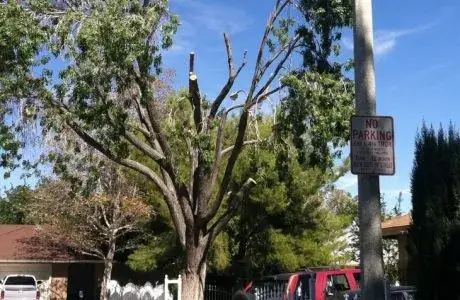
How many times have you looked at your tree and said, “That tree is too tall. I need to have it topped!” Come on, I know you’ve at least thought it, right? You might remember that sign at the amusement park stating “You must be this tall to ride”. Trees have no owner’s manual that say “I’m not allowed to exceed 30 feet”. Before you make the decision to reduce the height of any tree, do your research. Let me tell you why… TOPPING HURTS TREES! When a tree is topped, the upper crown is cut indiscriminately at a point that may not heal, also creating subsequent limbs that are more hazardous than what was removed. And that is just the beginning. We suggest you read this helpful brochure about Why Topping Hurts Trees. If you need to reduce the height of a tree, make sure you speak to one of our certified arborists to learn about the pros and cons.od but as this year’s bounty. Remember the rule when picking – two for the bucket, one for the mouth. Bon appetite!
Why Should An Arborist Trim My Trees?
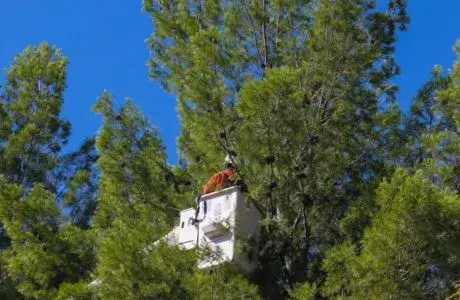
Now that spring is around the corner, and temperatures are on the rise, trees are coming out of their slumber and treating our senses with leaves and flowers of magnificent color and smell. It is also the time most people say, in their best Thurston Howell the III voice, “My dear, I think we need to call our arborist.” Seriously – no they don’t. Most people will call the first name they see on the flyer taped to the bus bench or mass-produced business card stuck under the windshield whiper on their at the local strip mall. Or they may see a pickup truck with a ladder and a chain saw driving around their neighborhood with the advertisement “We Slash & Dash” plastered on the tailgate. What exactly IS an arborist? Well, he’s the ISA version of a licensed AMA Beverly Hills plastic surgeon, not your back alley non-licensed deals on wheels working out of an old ice cream truck. Let me put it another way – a Yugo with a Mercedes emblem is just a….” Okay, you got it. Now that I’ve painted a masterpiece in visual pastels, let’s get to the black and white. An arborist is a professional in arboriculture, the study of trees, vines and other woody plants, along with their cultivation and management. He is trained and experienced in the identification, diagnosis, care and maintenance of your trees and plants. These trees and plants are no less a part of your family than are your children, and you should entrust them with the same care you expect from your health care professional. He’s not the professional only millionaires can afford. Up to now, you’ve spent a commodity much more precious than money on your landscape – time. That is something you can never get back once you hire Joe Hack-a-Limb to perform his impersonation of a professional arborist. So, back to Joe Hack-a-Limb, working out of that deals on wheels ice cream truck – do you really want him around your property?
Can I Trim My Neighbor’s Overhanging Tree Branches?
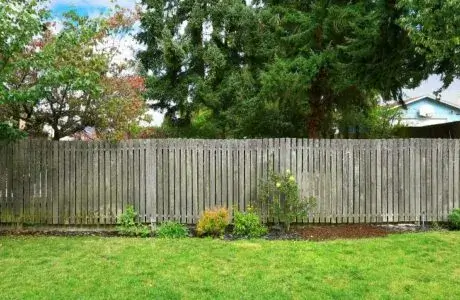
“My neighbor’s tree has branches crossing over my fence. Can you cut them back to their side? And while you’re at it, can you cut all the roots that are in my lawn?” If I had a dime for every time someone asked me that question, I’d be the better looking version of Bill Gates. No, not really, but I would be able to take the wife to a dinner and show at the dollar theater. Most of the public believes that they have the sovereign right to do whatever they want to do. Especially when it comes to branches or roots that encroach from a neighboring property. …but that isn’t true. Let’s look back at how the courts have ruled on this issue so we have a better understanding of the legal ramifications. In the 1994 case of Booska v. Patel, Patel (the neighbor) hired a contractor to remove the roots from the large Monterey pine his neighbor (Booska) owned. Patel claimed the roots had started to damage concrete around his property. The contractor dug a 3′ trench along the property line, effectively severing a significant portion of roots needed to survive. This damaged forced Booska to remove the tree, at his own expense, and to seek legal judgement. Ultimately an appellate court handed down a judgement that awarded him significant restitution. So, you’re wondering – is this the only case? Au contraire… In the 2012 case of Rony v Costa, a property owner hired an unlicensed day laborer to trim limbs that crossed his property line from a neighboring tree. Instead of researching the issue, the day laborer was turned loose on the trees like Jason in Friday the 13th. Except the trees were the unlucky cabin campers. For his efforts, the property owner was forced to pay restitution in excess of $45,000.00. Yes, THAT much. So, what is the take-away from all this you ask? First, familiarize yourself with your responsibilities as a property owner. Second, hire a certified arborist that knows the law and what you may and may not do. When people call us for an estimate on property line trimming, we ALWAYS start by informing them as to what their rights and responsibilities are. We also explain that what they want to do may not be legal or give them the outcome they desire. Ultimately, if there is no possible way of seeing eye to eye with your neighbor, consult lawyer that is familiar with aboriculture law. Click here for frequently asked questions to help you deal with troublesome trees on or near your property. trained in tree pruning to ANSI standards. Once you master this, you’ll not look at the trees as next year’s firewood but as this year’s bounty. Remember the rule when picking – two for the bucket, one for the mouth. Bon appetite!
10 Questions To Ask A Prospective Contractor

As a consumer, it is your right and responsibility to ask a contractor you might hire a few qualifying questions. The answers to these questions will determine whether or not you want him on your property, working for you. We at Tip Top Arborists welcome these questions because we now know that the potential client is concerned about their property and quality of work performed, NOT just the cost. So, what questions should be asked? Here are ten (10) common ones. 1. How long has your company been in business? Experience does matter. A seasoned contractor will provide you the peace of mind knowing that he can produce promised results. You have an investment in your property that you wouldn’t want to hand over to a novice – would you? 2. May I see your contractors license? States have stringent requirements for applying for a contractor license . In California, if you are performing work that exceeds $500.00 in labor/material you must be a licensed contractor. There are different types of licenses, too. Don’t hire someone that has a license for Landscaping (C-27) when you want Tree Trimming (C-61/D49). No only is the experience different, but what their insurance covers too. Here’s another item to note – California state law requires all forms of advertisement (cards, ads, truck signs, etc) carry the contractor’s license number. If you call that business card left on your front door or under your windshield wiper and ask the person that answers the phone for their license number, don’t be fooled by the “I’m sorry, I can’t give that to you until I come out to your house” spin. 3. Do you have a copy of your Liability and Workers Compensation insurance? Liability insurance protects your property from damage. Workers Compensation insurance protects YOU from a contractor’s employee injury on your property. Ask the prospective contractor for copies of both. If you hire a contractor that is uninsured, YOU take the responsibility of insuring them per CA Labor Code § 2750.5. (For an example of the consequences of hiring an uninsured company, refer to Fernandez v. Lawson). A contractor working out of classification may not carry the insurance to cover the work he is performing. While no one ever wants to be faced with an injury on the job site, one needs to be prepared. You, as the individual hiring a contractor, should have peace of mind knowing that the unforeseeable is covered. 4. How long will the job take? This is a question most don’t ask, but should. Your job should be the focus of your contractor and worked until completed. Only Mother Nature or some other unforeseen issue should delay completion. 5. What is your payment schedule? You NEVER pay the job up front, and a reputable contractor will never ask you to. California law states a contractor may not ask for more than 10% of the total job or $1000.00, whichever is less. Full payment upon completion of job is standard unless previous financial arrangements are made before the commencement of work. 6. Who will you send to perform the work? You should expect consistency from your contractor, especially with jobs that may take more than one (1) day. Tip Top Arborists will send only ISA-trained individuals will be sent to your project site, NOT someone picked up at your local home improvement outlet. 7. How do I stay in contact with you? In today’s world of technology, staying in touch should be easy. Whether it be texting, emails, phone calls or that oft-forgotten face to face conversation, have the discussion with your contractor on how it will be best to communicate. 8. What hours will you be working, do I need to be there and is there anything I need to prepare for? Your contractor should be able to give you a window of arrival time. For crews that have multiple jobs scheduled for the day, the first job of the day is usually the only one with a guaranteed start time. Most cities have a noise ordinance that, for weekdays, is usually 7 AM. To stay, or leave, is up to you. For the most part, tree trimming doesn’t require a homeowner present. But if you have a special bird bath given you by Great Aunt Gertrude, or a prized ’57 Chevy hubby is restoring, make sure those are brought to the attention of your contractor and crew. 9. What will my property look like at the end of the day? Any professional contractor will ensure that your property is clean at the end of the work day, whether it was a 2 hour job or one that runs multiple days. Tip Top Arborists treats your property as if it was our own. 10. How do you protect my property during work? Before work starts, the crew should walk the property looking for items that need to be moved or protected. Pictures of any existing damage should be taken and sent to the client before work starts to document the site. Remember Great Aunt Gertrude’s bird bath? The ’57 Chevy? Those items, and many other on the property, will be moved/protected during work. Plants, pool, patio furniture will be covered as required and any windows that might be at risk will be protected. At the end of the job, the site should look as good, if not better, than when the crew entered the property.
Are There Dangers In Cutting Tree Roots?
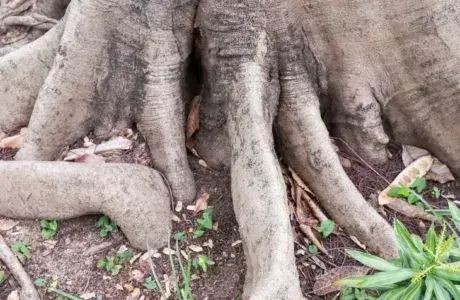
“Honey, I am so tired of looking at those roots in our front yard! I’m going to have the neighbor’s gardener, Joe Schmo’s Tree, Landscape, Automotive Repair and Concrete Service come over and cut them all out, okay?” Whoa there, Nellie!! There are many reasons why one sees roots in their lawn, and it isn’t necessarily because the tree is unstable or looking for water. Before you take a hatchet to those roots you first need to know what they do, why they are there and the law of Unintentional Consequences if you were to remove them. The Function of Roots Roots have two (2) basic functions – structure and feeding. Structure roots are those that start in at the base, growing under the canopy of the tree. As these roots move outward, they become smaller and smaller in diameter much like the structure of the limbs you see above. Their job is to provide a stable foundation. The feeder roots are small and fibrous and their job is to feed the tree, providing nutrients and water. So, you can see the distinct difference. Most people, when seeing roots, only see the structure roots, not the whole picture. The Pruning of Roots Remember the homeowner Nellie that wanted to go Lizzie Borden on the roots in her front yard? She doesn’t understand what potential consequences her actions may have on her tree. Here are just a few to consider – Construction and Landscape Renovation Adding onto the house for the out-laws? Installing a pool? Or just renovating your landscaping? These are another common area where roots have the potential to be cut and damaged. If you are installing a new irrigation system in your yard, try to incur minimal damage by installing irrigation like spokes on a wagon wheel as shown. Remember this rule of thumb – a tree will put out a root system at least as wide as the drip line. What do I need to know if I must prune roots in my yard? First off, remember that root pruning should NOT be for aesthetic reasons only. If the roots are damaging walkways or foundations, that is a different issue. But remember what we’ve discussed – pruning roots can have a negative effect on the tree. In your desire to save the foundation you might have weakened the tree causing it to fall on your roof. Ouch! Reach out to your local arborist for his professional opinion. Next, don’t cut roots larger than 2″ in diameter. The maximum one should consider removing in one procedure is 20% of above-ground roots. Again, remember the potential consequences. Is there a better time of year to prune or remove roots? Yes. winter thru early spring is the best time, as that is when there is the least stress on the tree. So, what do we take away from this. Yes, roots can be pruned with the knowledge of how/why they exist. They can also be pruned knowing what the potential outcome may be. If you are not sure, contact your local arborist for a consultation.
How Does Drought Affect Trees?
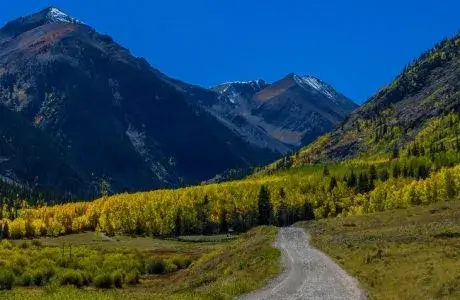
What Is “Drought” Before we start, we need to understand the definition of ‘drought’. Drought can be defined as a prolonged and exceptional deficit between water supply and demand. In other words, long term conditions of high demand and low supply equals drought. Many of us in the Southwest have experienced first hand the effects of years of drought, especially those living in California from 2011 thru 2017. With mandatory water restrictions to increased dusty conditions, the drought has altered all of our lives. However, many don’t know just how damaging the drought has been to trees that have been dependent on Mother Nature, both in natural and in domestic settings. Drought in Natural Setting First, let’s take the trees that are in natural settings. From the deserts to the mountains, native trees and plants depend on irrigation to not only grow but to defend themselves from outside pestilence. Hold on a minute. We just heard the phrase ‘defend themselves’. What does that mean? The simple answer is that when trees become stressed by lack of irrigation, they must redirect the energy allocated to defense and apply it to survival. In humanistic terms, you work long days for weeks on end, not getting the proper rest and nutrition, and eventually your defenses are down. The next thing you know, along comes the common cold or flu. You sneeze and sniffle, blowing you nose from time to time and that tells everyone around you that you are sick. Guess what – trees do the same. Okay, so none of us have ever heard a tree sneeze, but it does release chemicals such as ethanol, acetaldehyde, ethylene and ethane when stressed. These chemicals are catnip for ambrosia beetles, “secondary” bark beetles, and weevils. For our topic we’re going to talk about the secondary bark beetle effect. Bark Beetles The bark beetle attacks the weakest trees first, like the lion on the Serengeti attacks the slowest antelope in the herd. No, the bark beetle doesn’t have a long flowing mane and long tail. Instead, it’s only 1/8” to 3/8” in length. Not particularly daunting in size, right? Don’t let that fool you. When these beetles team up, they burrow through the vascular system of the tree, cutting off the flow of nutrients to and from the tree. Have you ever taken a sip through a soda straw that has a hole or slit, only to end up with a mouthful of air? Exactly what is happening here. Since the tree cannot distribute nutrients throughout the canopy, the furthest extremities will start to die off from starvation, eventually causing the entire tree to die. Meanwhile these bark beetles reproduce, flying off to infect the next victim. Not a pretty picture. Drought in Urban Setting Now let’s talk about trees in the urban setting. When the drought became a prolonged event, many cities have imposed watering restrictions in non-essential areas, such as landscaping. To comply with these restrictions, much of the public significantly reduced or eliminated the irrigation to the landscape which effected the trees residing in these areas. While at first these trees didn’t look as though affected by this reduction, internally they started going through the same stress process as those trees described in natural settings. These are signs of a tree in stress: Remember the bark beetle attacking native trees? They went after similar species of trees, and their cousins went after other varieties. Talk about a full-blown assault on our urban greenscape! Effects Installing Drought Tolerant Landscaping Doubling down of the drought water restrictions, many individuals went with native/drought tolerant landscape that required minimal irrigation. Through this process they laid down fake turf or plastic upon which they placed material such as gravel, bark or decomposed granite. This material in essence covered the roots of existing trees, robbing them of oxygen, water and nutrients while baking them under intense heat. Imagine trying to go throughout your day with a plastic bag over your head. I think you get the point. What You Can Do Now years into the drought, trees are falling over in our urban living areas. Cars are crushed, houses damaged and the public put at risk. What do we do? First off, contact an Arborist to look at your trees and give you an assessment of what he/she sees. He/she should ask you questions about the tree just as a doctor asks you questions about your history. This will help him/her provide a better assessment and recommendations. The effects of the drought will linger for years, if not decades. Make sure you do your part in protecting your trees, all while prevention potential risks to both person and property.
Cheaper Isn’t Always Better

Define a Professional Almost every professional in their industry can talk at great lengths about the issues they see on a daily basis. The ethical issues that give the profession a bad name. The companies that claim to be the cheapest. The unprofessional work that is sold as ‘quality service at a reduced cost’. The only problem is that this cheap service, or the service billed at a reduced cost, doesn’t always match up with the client’s desired outcome. To have the cheapest, somewhere there is a tactic used to cut corners. Here’s another way to look at it – Cheap labor isn’t skilled. Skilled labor isn’t cheap. So how does this pertain to something as simple as trimming trees? We should look at this as not too dissimilar of one’s approach in seeking a medical professional to take care of our children. Our trees are a living and breathing organism, are they not? They require nourishment and loving care, allowing them to grow into the family member they’re meant to be, right? Why, then, would we want to cut corners and skimp on care that could mar or permanently disable them for life? Turns out tree care isn’t so simple, is it. A Tale of Two Potential Outcomes Let’s tell a story many of us can relate to, whether a personal or an acquaintance’s encounter. John has a majestic Bradford pear in his front yard. It’s the most beautiful tree in the neighborhood, with a perfect shape that is the envy of everyone on the block. John has noticed that over the years the tree has started to encroach on his roof line, along with the service line in front of his house. Not wanting issues with either critters accessing his attic, or the risk of taking out the neighborhood power in a wind storm, he decides it’s time to prune the tree. Now John has an idea of what he wants the tree to look like. So, he gets out his smart phone and types “tree trimming” into the search bar and up comes a dozen names. As most consumers, he starts calling the numbers for quotes. Some of those phone numbers give a price over the phone, sight unseen while some give a price after John has texted them photos. Some come out and give John a price written on the back of a scrap piece of paper or business card, while one or two hand him a written proposal. After getting all this pricing, John, again as a consumer with a budget, picks the cheapest of the bunch – Slash ‘N Dash Tree Service. With tomorrow set as the big day, he anxiously spends a sleepless night thinking about his majestic tree and how good it will look tomorrow. The morning arrives, as does the crew representing the company. Pickup trucks, trailers, ladders and tools are distributed around his property and with little ado they don their climbing gear consisting of a climbing saddle, lanyard, climbing rope and climbing gaffs. Like monkeys with chain saws, the climbers swiftly attack the areas of concerns, cutting limbs that drop to the ground like spring snow. Groundmen quickly take the dismembered limbs and toss them into awaiting trailers, raking the grass and planters clear of smaller debris. All in all, this took a little over an hour. Just as quickly as they arrived, they depart with the same speed after holding out a hand to receive a check from John. A Gullible Guy Heard this story before? Hold on, the best is yet to come. As weeks turn into months, John noticed that the once perfectly shaped tree was taking on the image of Igor, hump and all. Not only that, sap was oozing from the trunk and the ends of some limbs looked like they’d been hit with a blow torch. So he called Slash ‘N Dash Tree Service but no one returned his messages left on voicemail. By this time John was beginning to panic. He called around, finding a Certified Arborist that for a small fee would look at his tree. Remember the climbing gaffs the climbers used? They tore wounds in the trunk and the oozing sap was the trees’ attempt at healing the gouges. Remember the tools strewn over the front lawn? Well, the crew had pruned a diseased tree and didn’t clean them, passing fire blight onto the pear. And Igor’s hump? By cutting only specific areas without regards to the entire crown, it developed an imbalance in shape. So where is John’s crown jewel of the neighborhood today? He still has it, but it’s going through a long process of healing and pruning in the hopes it might become great again. The Cliff Notes The point of the story? As professionals in the tree care industry, we see these horrific but preventable stories every day. By making yourself aware of the long-term effect of hiring the first and cheapest company you talk to, the chances of you learning the hard lesson of John diminish greatly. Do your research. Make referral calls. Look at reviews. But more importantly – make sure you are hiring a true professional that has the education, knowledge, expertise and all the required licenses and insurance required to take care of your precious commodity – your trees. They are your children.
When Disease Comes Calling: How Healthy Trees Get Sick

Arborists have long attempted to portray how trees live as a reflection of how humans live. Trees, like humans, need sustenance, care and a healthy diet or else they can become sick from an onslaught of potentially life threatening bacterial and viral diseases that can be airborne or vectored (wind, birds,insects. insects and tools). People should know their trees and what type of diseases can infect them. Let me share a not too uncommon story about how a once healthy tree comes down with a severe case of a bacterial infection. Good Intentions Over the spring weekend, Mac noticed that his Bradford pear had branches that were hanging close to his roof line, causing concern for both him and his insurance company. He decided that when his landscaping company came Monday to mow the lawn and hedge his shrubs, he’d ask them to trim the pear back from the roof line. Monday arrived and the landscapers showed up, unloading their equipment for the weekly service. Mac approached Bobby, the foreman, with the request and received a “no problem” in response. In a short time an extension ladder, rusty power hedgers, worn pole pruner and a pair of dull loppers appeared. After a few cuts the roof was cleared. Satisfied, Mac gave the crew an extra $40.00 for the work. Problem solved, thought Mac. Or was it .. Spring turned into summer, summer into fall. With Halloween approaching, Mac started planning out his annual scary outdoors display. Included was a feature where a ghost flys down from his chimney to the same pear tree trimmed by his landscapers in spring. With a cable in hand, Mac climbed his A-frame ladder to attach it to the tree when he noticed what appeared to be burned branch segments on the pruned side of the tree. The closer he looked, the more they looked like they had been scorched with a blow torch. Shrugging his shoulders, Mac didn’t give it a second thought. After he attached the cable and climbed off the ladder, he looked at the rest of the tree but didn’t see any other foliage with similar appearance anywhere else. But as he glanced over to the pyrcantha hedge that wrapped around the front of his house, he also noticed a similar burnt appearance on the ends of branches. Now he was perplexed. Transmission of a Disease So what happened? When Mac’s landscapers came to his house that spring day, they had just trimmed pyracantha and crab apple at another property that were infected with a bacterium called Fireblight. The bacteria remained onto their pruning tools. When those same tools touched Mac’s tree and shrubs, they became infected. Stories like this happen every single day. Signs like tree trunks turning black are often indicative of fungal infections or diseases like Fireblight, which may affect the entire tree if not treated promptly. How to Reduce Risks So how can we avoid cases like this? First, we need to pay attention to the species of trees and shrubs we have, along with knowing what diseases they can contract. In today’s age of the Internet, looking up that info is relatively easy. Second, if you hire someone to maintain your trees and shrubs, make sure they know diseases and enter your property with sterilized tools. You’d be aghast if you knew how many so called ‘professionals’ don’t know the first thing about diseases. We understand it’s impossible to protect your property from diseases that are vectored in by the wind, birds or insects. However, if you or your professional do the following things you can reduce the risk of infecting your trees and shrubs*: You’d no sooner let a medical professional treat your or your family with an unsterilized tool – why treat your trees and property any different? * source: Dr. Linda Chalker-Scott, “Sterilized Pruning Tools: Nuisance or Necessity?”
COVID-19 Update

A Message to our Customers We want to assure you that we remain open and ready to serve because our company is considered an essential service provider. As such, we will continue to provide all our customers at home or work the highest level of tree care service in your community. All of our outside tree workers and estimators have been instructed to closely follow the recommendations of the Centers for Disease Control (CDC) for protecting themselves and others. These recommendations include avoiding exposure to others (Safe Social Distancing), wearing gloves or frequent and thorough hand washing and the use of hand sanitizer, disinfecting wipes and cleaners. We wish you the best of health and look forward to providing you the best tree trimming and removal service during this difficult time.
Pruning Your Fruit Trees

How, When, Why to Prune Fruit Trees Many people love the idea of having fresh fruit growing in their backyard orchard. For the experienced, maintaining their labor of love is easy. For the inexperienced, they soon realize it’s something more like love to labor. It’s like raising a child – there are years of training, shaping them for their development, all while warding off pests and diseases that will shorten their lifespan. This work hopefully leads to something that bears good fruit. Well, maybe raising a child doesn’t require pruning off limbs, thinning out the insides and heading from time to time (although sometimes we’re tempted…….). But your trees do. So, let’s talk about the basics. Winter is usually the preferred time to trim, as you are priming the tree for spring growth. You can trim during the growth season but remember that could possibly reduce fruit development along with opening up the tree to outside pests and diseases. Step One: Cleaning up the tree Step Two: Thinning out the interior Step Three: Heading back the crown Think you’re done? Not quite. Make sure you dispose of all the cuttings to ensure that any diseases that they might contain do not linger around the property. And speaking of diseases – treat your tools in a solution of isopropyl alcohol before moving onto another tree. And consider using dormant oil. It is a non-toxic spray, applied via a pump sprayer that helps control insects such as scale and mite that can damage the tree. Generally, it is applied in late winter/early spring, but follow the MSDS label for application information. Not sure if you want to tackle the job? Call one of our certified arborists if you live in our service area. They will know the ins and outs of trimming your trees, whether they fruit or not. They are trained in tree pruning to ANSI standards. Once you master this, you’ll not look at the trees as next year’s firewood but as this year’s bounty. Remember the rule when picking – two for the bucket, one for the mouth. Bon appetite!