
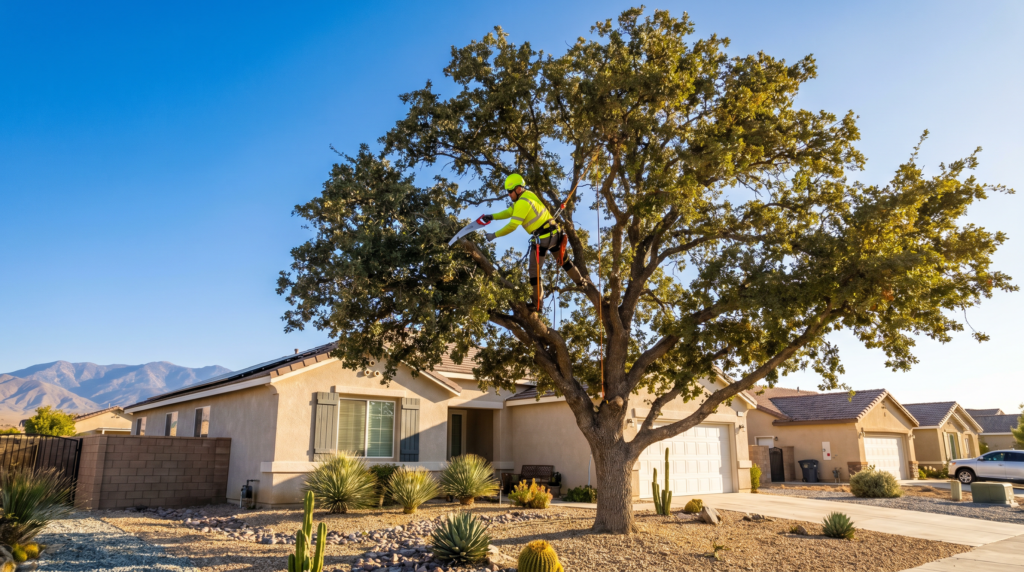
One of the most common questions Tip Top Arborists receives from homeowners across Lancaster, Palmdale, and Acton is a simple one: how long will this trim last? It is a practical question that matters for budgeting, planning, and understanding what your trees actually need.
The honest answer is that it depends – but not in a vague way. There are specific, measurable factors that determine how quickly a tree regrows after trimming, and understanding them allows you to plan your tree care schedule with confidence rather than guesswork. This guide explains those factors and gives you a clear framework for thinking about tree trimming frequency in the Antelope Valley.
For most mature residential trees in the Antelope Valley, a professional trimming visit every two to three years is the appropriate maintenance interval. This is the guidance Tip Top Arborists provides to the majority of our clients after completing a job.
However, that two-to-three-year window is not a universal rule. It is a starting point that gets adjusted based on the specific tree, its location, and the conditions it is growing in.
Different species grow at dramatically different rates. Mulberry trees – by far the most common trimming request in the Antelope Valley – are fast-growing and may require attention every one to two years in irrigated residential settings. Ash trees grow at a moderate pace and typically fall into the two-to-three-year range. Mature pine trees, once properly shaped, may only need attention every three to five years.
Trees in irrigated residential landscapes grow significantly faster than trees in dry, unirrigated settings. A mulberry tree on a regular drip system in Palmdale will regrow its canopy much faster than the same species growing on rainfall alone in a rural Acton property.
The type of work done at the last visit directly affects how long it lasts. Crown thinning, which removes interior branches while preserving the overall structure, tends to hold well for two to three years. Crown reduction, which reduces the overall size of the canopy, typically requires a follow-up visit sooner because the tree responds by producing vigorous new growth at the cut points.
Trees growing near rooflines, gutters, or utility lines need more frequent attention because the acceptable clearance margin is smaller. A branch that would be fine on an open-canopy tree may become a hazard within 12 months when it is growing toward a structure.
The Antelope Valley’s wind events can set back a trimming job significantly. A tree that was well-shaped in the spring may have broken or displaced branches by the following autumn. Annual inspections are advisable for trees in exposed locations or near structures, even if a full trim is not needed every year.
When Tip Top Arborists completes a trimming job, our arborists provide a specific maintenance timeline based on the tree’s species, growth rate, and the work performed. For many of our Palmdale and Lancaster clients, that timeline is two years.
Palmdale homeowner Mina Monden, who has been a Tip Top client for nine years, noted in her recent five-star review that after her most recent trimming, she was told the tree would not need attention again for two years. That kind of specific, honest guidance is what allows homeowners to plan and budget rather than react.
Even with a clear maintenance timeline, certain conditions should prompt an earlier visit:
If any of these apply, call Tip Top Arborists for an assessment before the next scheduled visit.
A: Mulberry trees are fast-growing and typically require trimming every one to two years in irrigated residential settings in Palmdale and Lancaster. In drier, unirrigated conditions, the interval may extend to two to three years.
A: Yes. Crown thinning, which removes interior branches while preserving the tree’s overall structure, tends to hold well for two to three years. Crown reduction, which reduces the overall canopy size, typically requires a follow-up sooner because the tree responds with vigorous new growth at the cut points.
A: Look for branches growing within 18 inches of your roofline, dead or hanging branches in the canopy, a noticeably unbalanced shape, or any growth toward power lines or structures. Tip Top Arborists also provides a specific maintenance timeline at the end of every job.
A: For most mature trees in the Antelope Valley, annual trimming is not necessary. However, annual inspections are advisable for trees near structures, power lines, or in high-wind exposure areas, even if a full trim is not required every year.
A: Yes. Tip Top Arborists tracks maintenance timelines for our clients and can provide reminders when your trees are due for their next visit. Call (661) 382-8722 to discuss a maintenance plan for your property.
Homeowners looking for professional tree trimming can visit
https://tiptoparborists.com/tree-trimming-palmdale-ca/ for full service details.
If you’re located in the area, explore local services here:
https://tiptoparborists.com/palmdale/
Need expert advice? Request a free estimate today:
https://tiptoparborists.com/contact-us/
Understanding trimming frequency allows you to plan your tree care as a predictable annual or biennial expense rather than an emergency cost. A well-maintained tree trimmed on schedule is significantly less expensive to care for over time than a neglected tree that requires emergency intervention.
Tip Top Arborists offers free estimates for all residential trimming in Lancaster, Palmdale, Acton, Quartz Hill, and the surrounding Antelope Valley. Our arborists will assess your trees, explain what they need, and give you a clear timeline and cost estimate with no obligation.
Call (661) 382-8722 or visit tiptoparborists.com to schedule your free estimate.
Tell us about your tree care needs and our team will follow up with a detailed estimate and recommended solutions.