
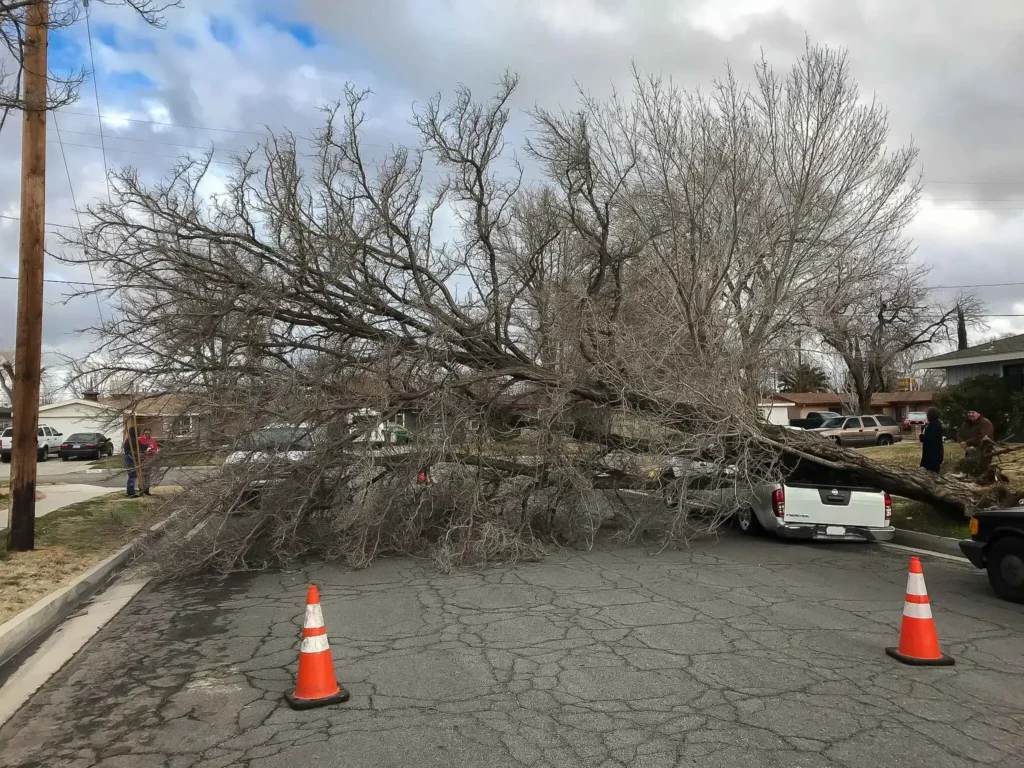
Lancaster CA is known for its beautiful high desert landscapes, but it is also famous for its intense wind events. When the wind howls through the Antelope Valley, trees can take a serious beating. If you wake up after a storm to find broken branches or leaning trunks in your yard, knowing exactly what to do can save your property from further damage and protect the health of your trees.
In this guide, we will walk you through the immediate steps to take when you discover wind storm tree damage on your property. From assessing the danger from a safe distance to knowing when to call in the professionals, we have you covered.
The very first thing you must do after a wind storm is ensure the safety of your family and neighbors. Fallen trees and broken branches can create incredibly hazardous situations.
Before you even step foot in your yard, look up and around. If a tree or large branch has fallen on or near a power line, do not approach it. The ground around the tree could be electrified. Call your local utility company immediately to report the downed line, and keep everyone away from the area until professionals declare it safe.
Sometimes the most dangerous branches are the ones that have not fallen all the way down yet. Look up into the canopy of your trees. Are there large, broken limbs hanging precariously? These are known as “widow-makers” in the tree care industry because they can drop at any moment without warning. If you see hanging branches, avoid walking under the tree and keep pets and children indoors.
If a tree has fallen onto your house, car, or other structures, evacuate the area if necessary and contact your insurance company. Do not attempt to remove the tree yourself if it is resting on a structure, as shifting the weight could cause the structure to collapse further.
Once you have ensured that the immediate area is safe from electrical hazards and imminent falling debris, take time to document the damage. This step is crucial if you plan to file an insurance claim.
Take clear photos and videos of the damaged trees from multiple angles. Capture the entire tree, the specific broken areas, and any property damage caused by the falling limbs. If the tree was uprooted, take pictures of the exposed root system and the hole left in the ground.
Write down the date and time of the storm, as well as a detailed description of what happened. Having this information ready will make the insurance claims process much smoother.
Not all wind damage means a tree has to be removed. Many trees can recover from storm damage with the right care. Here is how to evaluate the situation.
If the tree has only lost small branches and the main trunk is intact, it will likely recover just fine. You can clean up the small debris yourself. However, the broken ends of the branches should be pruned cleanly to prevent disease and pests from entering the tree.
If the tree has lost larger limbs but the trunk is solid and the overall structure remains balanced, it may still be salvageable. A professional arborist can assess the tree and determine if selective pruning can restore its health and appearance.
Severe damage occurs when the main trunk is split, the tree has lost more than half of its canopy, or it has been significantly uprooted. In these cases, the tree is often beyond saving and will need to be removed safely.
It can be tempting to grab a chainsaw and start cutting away the damaged parts of your tree, but DIY tree repair is incredibly dangerous. Tree work is consistently ranked as one of the most hazardous professions, and doing it without proper training and equipment is a recipe for disaster.
Cutting branches under tension can cause them to snap back violently. Chainsaw kickback can cause severe injuries. And without a deep understanding of tree biology, you might make improper cuts that doom the tree to a slow death from disease or rot.
For anything more than picking up small twigs from the ground, it is always best to hire a certified arborist.
When you are dealing with wind storm tree damage in Lancaster CA, bringing in a professional is the smartest move you can make. An International Society of Arboriculture certified arborist has the training and experience to handle storm damage safely and effectively.
When an arborist arrives at your property, they will conduct a thorough assessment of the damaged trees. They will look for hidden structural weaknesses that might not be obvious to the untrained eye.
If the tree can be saved, the arborist will perform corrective pruning. This involves making clean cuts to remove broken branches, which helps the tree heal faster and prevents decay. They will also balance the canopy to ensure the tree is stable and less likely to fail in the next wind storm.
If the tree must be removed, the arborist has the specialized equipment to take it down safely, even in tight spaces or near structures. They can also grind the stump, leaving your yard clean and ready for new landscaping.
While you cannot control the weather, you can take steps to prepare your trees for the high winds that frequently hit the Antelope Valley.
The best defense against wind damage is a well-maintained tree. Regular pruning removes dead or diseased branches before they can be ripped off by the wind. It also thins the canopy, allowing wind to pass through the tree more easily rather than pushing against it like a sail.
When adding new trees to your landscape, choose species that are known to be wind-resistant. Plant them in locations where they will have enough space for their roots to grow deep and strong.
Trees that are drought-stressed are more brittle and prone to breaking in high winds. Ensure your trees are receiving adequate water, especially during the hot, dry summer months.
A: In many cases, homeowners insurance will cover the cost of tree removal if the tree has fallen on a covered structure, such as your house or garage. If the tree falls in your yard without hitting anything, insurance typically will not cover the removal. It is best to check with your specific insurance provider.
A: Hanging branches, or widow-makers, should be addressed immediately. They pose a significant safety risk as they can fall at any time. Keep people and pets away from the area and call a professional arborist as soon as possible.
A: It depends on the severity of the split. Small cracks might heal, but a major split in the main trunk usually compromises the structural integrity of the tree, making it a hazard. An arborist must evaluate the tree to determine if it can be saved with cabling and bracing or if it needs to be removed.
A: No. Using a ladder for tree trimming is highly dangerous. The shifting weight of the branches as you cut them can easily knock the ladder over. Professional arborists use specialized climbing gear or bucket trucks to work safely at heights.
Dealing with wind storm tree damage can be stressful, but taking the right steps can minimize the impact on your property and your wallet. Remember to prioritize safety, document the damage, and rely on the expertise of a certified arborist for repairs and removals.
If you need help with storm-damaged trees in Lancaster CA or anywhere in the Antelope Valley, do not hesitate to reach out to the professionals.
Call Tip Top Arborists today at (661) 245-0250 for expert tree care and storm damage assistance.
Contact Tip Top Arborists → https://tiptoparborists.com/contact-us/
Tell us about your tree care needs and our team will follow up with a detailed estimate and recommended solutions.